Posts

Choosing to Follow

Image
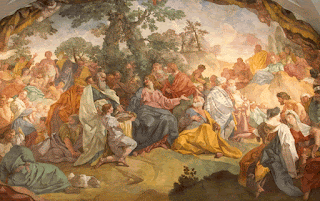
Joshua 24:1-2, 15-17, 18b Psalm 34 St. John 6:60-69 In our Old Testament and Gospel readings, two groups of followers of God are challenged in their intention. The Israelites answer Joshua saying that they will not "forsake the Lord" (Jos 24:16), and Peter on behalf of the twelve responds to Jesus with these incredible words: Master, to whom shall we go? You have the words of eternal life" ( Jn 6:68). What's interesting to me is their reasons why. The Israelites had just gone through a period of victory in battle followed by peace and "rest from their enemies" (Jos 23:1). And in their reply to Joshua, they cite the goodness of the Lord in their past-- the way he brought them out of Egypt, out of slavery, performed miracles before their very eyes, and so on (24:16). They can look back in history and point to how God has been faithful to them. At first reading, I struggled a bit with this passage, and with the Psalm which so cleanly parallels it, bec...
Woe, ye Shepherds.

Image
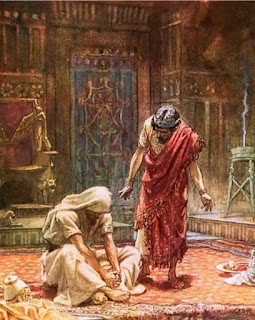
Ezekiel 34 St. Matthew 24 I am writing this week with a very heavy heart, in the aftermath of the devastating news from Pennsylvania. In light of this crisis and a response from the Vatican press office which can be described as "underwhelming," this week we are departing from commenting on the lectionary. In stead, we are taking as our texts Ezekiel 34 and St. Matthew 24. The Sorrow of King David William Brassey Hole The history of the People of God is a history of crisis. The summary of the book of Judges given in chapter 2 is a cycle well known to us. Sin is followed by God's redemption, which is followed by our self-satisfaction and further sin. And the history of the Church is no different. No sooner was the controversy with the Judaisers (Eusebius and Epiphanius know them as the Ebionites) resolved in Acts 15, then the controversy with the Gnostics began. Followed immediately by the Arian controversy, which was not yet resolved when the Church faced the ris...

For the Life of the World

Image
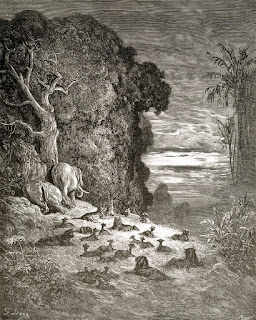
St. John 6:41-51 In "The Pain of Animals: A Problem in Theology," C.S. Lewis points out that Satan rebelled before mankind, and that his work might be seen in the widespread "distortion" of God's created order, noting that "(in particular) the insect world appears to be Hell itself visibly in operation around us." Gustave Dore, "The Evening of the Seventh Day" illustration for Paradise Lost Our conversations about redemption are rightly focused on our own story: God became man and gave himself up for us. But it is good to call to mind that there is more to this story. All of creation is marred by the cosmic war in which we find ourselves. Nature itself is deeply scored and does not escape the consequences of the Devil's fall from grace. Christ addresses this in today's Gospel: "The bread that I will give is my flesh for the life of the world." Our fate is bound up in the fate of the cosmos, this dust and ash, thes...

To See if they Obey My Law

Image
Exodus 6:2-4, 12-15 Psalm 78:3-4, 23-25, 54 St John 6:24-35 This week I find myself in the enviable position of getting to write a second reflection on the Bread of Life discourses in St. John chapter 6. But this section of the discourse has an element that we do not usually look at, and it is a theme that runs through all of our texts this week. Ethiopian Orthodox icon of the Last Supper In Exodus 16:4, God tells Moses that he will send Manna to feed the Israelites, and he explains why "To discover if they will walk in my Law or not." The gift of Manna is surrounded by instructions: take only what the day requires, do not gather on the Sabbath. God desires to know if His people will honor the gift of sustenance which He has given. Will we give in to greed? Will we give in to anxiety? Will we be obedient to the Divine Law handed down? Will we rely on God for our daily bread? The Psalmist carries this theme forward. God "opened the doors of Heaven" and ...

One loaf and one cup

Image
Ephesians 4:1-6 St. John 6:1-15 In today's gospel, St. John gives us a subtle hint toward the context of the Feeding of the Five Thousand. In verse four he mentions that "The Passover, a feast of the Jews, was near." (AV) The miracle of the multiplication of loaves and fish draws on Paschal imagery, reminding us of the manna, but also as Christians of Christ's paschal sacrifice for us. The multiplication of the loaves and fishes Gregorio Guglielmi  The crowd brings this up in verses 30-31, a not very subtle hint to our Lord, "What sign shewest thou, then, that we may see and believe thee?...Our fathers did eat manna in the desert." (AV) But Christ points the gift of bread back to himself, "The bread of God is that which cometh down from heaven and giveth life to the world...I am the bread of life: he that cometh to me shall never hunger," verse 35. The feeding of the five thousand is only an image, an illustration, of the Eucharistic f...

In the Desert with Christ

Image
Jeremiah 23:1-6 Ephesians 2:13-18 Mark 6:30-34   When Jesus landed and saw a large crowd, he had compassion on them, because they were like sheep without a shepherd. So he began teaching them many things.             To be among God’s people, to earnestly seek after Jesus, is inevitably to find oneself within some desert or wasteland.             A woman wakes up twenty years into a marriage, and thinks, “is this it? Really?” She makes the inventory of her life as a celebrated library, low-level politician. She counts the birthdays of her children. She remembers that her children now have their own children. Her husband snores. So does she. Christ the Good Shepherd Third Century             A man feels the stiffness on his shoulder, arm, legs, as he goes up for a shot. He knows that th...