Posts

The Second Sunday in Lent: The Work of Our Sanctification

Image
Epistle: 1 Thess 4:1-8        Gospel (Roman): St Matt 17: 1-9 ;     (Sarum& BCP): St Matt 15: 21-28 Collect : Almighty God, who seest that we have no power of ourselves to help ourselves; keep us both outwardly in our bodies and inwardly in our souls; that we may be defended from all adversities which may happen to the body, and from all evil thoughts which may assault and hurt the soul; through Jesus Christ our Lord. Amen. In the midst of life’s travails and worries, in the face of our personal failures and frustrations, we are often prone to wallow either in self-pity and pride, or in despair. We may even grumble against God and dispute the ordinances of his sovereign will. The magnitude of our sufferings weigh us down so much that we dare not call out for help. We settle upon well-rehearsed excuses (all too readily supplied by a modernist and Godless psychology) for our sins, habitual or not. We sometimes erect our sorrows and our sins...

The First Sunday of Lent : All Creatures of our God and King

Image
Genesis 9:8-17                  There is a concept found in many cultures and traditions that has always attracted me. Put simply, it is the idea of the interconnectedness of all things. The ant that crawls on the stem of some forgotten leaf scratches some light itch of the universe. We are all permutations of stardust, from whence we come and shall return. This “ we ”, as God reminds us in the story of Noah, is not limited to just humanity. Birds, livestock, wild, domesticated, all living things were touched by the flood, just as all living things are affected by the actions of each member within the ecosystem. To see a World in a Grain of Sand  And a Heaven in a Wild Flower  Hold Infinity in the palm of your hand  And Eternity in an hour (Wm. Blake, Auguries of Innocence) (An icon of the Creation of the Universe) We can see in the Scriptures and the tradition that ...

Remembering that We Are Dust

Image
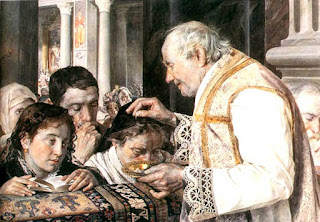
Spending Ash Wednesday ill in bed, I was unable to write an appropriate reflection for the Fellowship, or even attend mass. The only devotion I managed was reciting Psalm 103 in my little Authorized Version psalm book. Of course, I chose this psalm because I remembered that it echoed the line from Genesis, "Dust you are and to dust you shall return." (Gen. 3:19) Imagine my surprise, then, to realize when I reached verse 14 that in fact it read, "For he knoweth our frame; he remembereth that we are dust." Polish priest imposing ashes (unknown, 1881) The Psalmist has taken a refrain from throughout the Old Testament, a reminder to mankind that we are mortal, that we are sinful, and that we must act accordingly, (see Eccl. 5:15, Ps. 104:29, Isa. 40, and Ps. 90) and turned it on its head. There is more to "Ashes to ashes and dust to dust" than only the command to "redeem the time, because the days are evil." (Eph. 5:16) There is another side: t...

The Leper of Christ: Reflection on the Sixth Sunday in Ordinary Time

Image
Leviticus 13:1-2, 44-46 I Corinthians 10:31-11:1 St. Mark 1:40-45 By: Matthew David Wiseman Leprosy is usually associated with what is called Hansen's Disease, and not without some reason. Both are highly contagious skin infections which have traditionally excluded people from society. However, even a cursory reading of today's lection from Leviticus makes it clear that the biblical leprosy is not the same as Hansen's Disease. There is no deformation of fingers and toes here, and the lesions are rather different from Hansen's. The truth is that there is no clear disease or pathology which these chapters of Leviticus describe. In fact, some Jewish commentators conclude from this that there is no such disease, but rather that leprosy was a special curse from God. Ikon of Christ cleansing the leper All of this only contributes to the strangeness of what is already, for modern readers, a very strange story in St. Mark chapter 1. In our socially conscious, ev...

The fifth sunday in Ordinary Time

Image
Job 7:1-4, 6-7 St. Mark 1:29-39 By Evan Underbrink             If you were to scan literature section of your local library or bookstore, I would bet that you’d find the happy endings are outnumbered, flanked on all sides. Upon that library shelf, where all the timeless classics reside, you'll find the joyful ends of the Divina Commedia and Odyssey . But surrounding these on all sides there is a Hamlet , Antigone , Media … Job on the dunghill, Gonzalo Carrasco             This is really no surprise that the really profound works have some necessary glare into the dark. As human beings, we do not like to contemplate death or tragedy much, and so it is right for books and art to take is places we wouldn't readily go. What benefit is there to the melancholy of death? I mean here true death and grief, not the fondled desires of morbid minds, wondering how peopl...

Depart in Peace: The Feast of the Presentation of the Lord.

Image
Malachai 3:1-4 Hebrews 2:14-18 St. Luke 2:22-40 Lord, now lettest thou thy servant depart in peace, according to thy word. For mine eyes have seen thy salvation, Which thou hast prepared before the face of all people; To be a light to lighten the Gentiles, and to be the glory of thy people Israel. (St. Luke 2:29) Today, the Feast of the Presentation (historically the Feast of the Purification of Mary), marks the end of the celebrations of the Incarnation. In today's Gospel, Christ is taken to the Temple to be presented. According to Exodus 13, God claims the firstborn sons of Israel because they were spared in the Plague of the Firstborn in Egypt, making them holy. The image of Christ in this observance is startling: death passes over the firstborn of Israel, redeeming them from slavery and sanctifying them to God, a symbol of the death and resurrection of the firstborn of the Father. Mosaic of the Presentation. Jesuit infirmary, Rome. At the Temple, the Holy Family...

Reflections on Septuagesima Sunday

Image
Epistle : 1 Corinthians 9:24 – 10:5      Gospel : St Matthew, 20:1-16 Collect : Graciously hear, we beseech thee, O Lord, the prayers of thy people: that we, who are justly afflicted for our sins, may be freed by thy mercy for the glory of thy name. Today, in those communities that use either the Extraordinary Form of the Roman Rite or the Ordinariate Rite, the Sunday of Septuagesima is kept. This Sunday marks the beginning of the three weeks of preparation before Lent. The solemnities of Christmas and of the Epiphany, in which we celebrate the Mystery of the Incarnation of the Eternal Word of God, are behind us. Now, this season of Fore-Lent opens for us a new cycle in the liturgical year that will take us through the drama of our Redemption, culminating in the holy celebrations of Easter, of Our Lord’s victory over death. It is a prelude to the preparation that is Lent. It may seem redundant that we have to prepare ourselves before entering a time of -- p...