Posts

Reflections on Septuagesima Sunday

Image
Epistle : 1 Corinthians 9:24 – 10:5      Gospel : St Matthew, 20:1-16 Collect : Graciously hear, we beseech thee, O Lord, the prayers of thy people: that we, who are justly afflicted for our sins, may be freed by thy mercy for the glory of thy name. Today, in those communities that use either the Extraordinary Form of the Roman Rite or the Ordinariate Rite, the Sunday of Septuagesima is kept. This Sunday marks the beginning of the three weeks of preparation before Lent. The solemnities of Christmas and of the Epiphany, in which we celebrate the Mystery of the Incarnation of the Eternal Word of God, are behind us. Now, this season of Fore-Lent opens for us a new cycle in the liturgical year that will take us through the drama of our Redemption, culminating in the holy celebrations of Easter, of Our Lord’s victory over death. It is a prelude to the preparation that is Lent. It may seem redundant that we have to prepare ourselves before entering a time of -- p...

Face to Face: Creating a Culture of Encounter

Image
Two stories have broken this week which highlight one of the primary concerns of our Community: a breakdown in our society's ability to have a conversation. First, an interview with the psychologist Jordan Peterson went viral. The reasons for its popularity had mainly to do with the positions he took which are more friendly to Conservatives than those that are often given either in major media outlets, or by academics. But what struck me most when watching the interview is a point covered very well by the Atlantic's Conor Friedersdorf, that the interviewer did not seem to hear or understand what Peterson was actually saying. Instead she consistently caricatures him and sets up straw men to knock down. John William Waterhouse's "The Favorites of the Emperor Honorius" When told that Rome fell to the Vandals, Honorius thought the chicken he had named "Rome" had died, and was relieved to find out it had not. This is only one prominent example o...

Friends of God: the third Sunday after Epiphany

Image
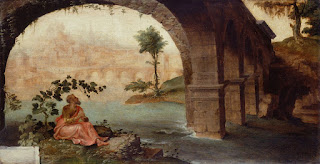
Jonah 3:1-5, 10 St. Mark 1:14-20 The truth will come out; that is the nature of truth. But human nature is not so certain. If we share the truth without love, we risk Jonah’s end, alone beneath the dead trees which might have borne us fruit. (Jon. 4:2, 7-8) If we share in love, we may often be returned hatred. But if we share the truth from a place of simple love for those with whom we share, like Christ did, we rarely spend life alone. (Eph. 4:15-16) Van Heemskerck's Jonah under the Gourd The cure for loneliness is spiritual friendship, like Abraham’s friendship with God, (Isa. 41:8-10) or the old Irish idea of the “soul friend.” And I do not mean that loneliness which strikes like some hunger pang, and is satiated by joining the virulent roustings of humans: to meet and drink and sing carouse. This is earthly desire, and is even a great good in its season. (Eccl. 3:4) I mean the loneliness which is the shadow of our own soul. This portion of our being is ...

The Dwelling of God is with Mankind: the second Sunday after Epiphany, A.D. 2018

Image
I Samuel 3:3-10, 19 St John 1:35-42 When St. John the Baptist tells the two disciples that Christ is the Lamb of God, they immediately turn aside to follow him, but their first question to him surprises us. They could have asked "Are you the one who is coming?" (Matt. 11:3), they could have asked "Art thou the Christ, son of the Blessed?" (Mrk. 14:61), or else "What shall I do to inherit eternal life?" (Lk. 18:18), or "What shall we do that we might work the works of God?" (Jhn. 6:28) or even something more practical like, "how shall we pray?" (Lk. 11:1) God calls Samuel while he dwells in the Temple These are the sorts of questions that people usually ask Christ in the Gospels, and for obvious reasons. So we should be taken off guard when Andrew and the other disciple ask "Where are you dwelling?" But on reflection, we shouldn't be surprised. St. John began the chapter by making this same point, "And the Wor...

The Epiphany of Our Lord, 2018 A.D.

Image
Isaiah 60:1-6 St. Matthew 2:1-12 The thing that stood out to me most on this reading of the lessons for Epiphany is their relentless use of the imagery of Empire. In Isaiah, the kings of the world come to the light of God's people, bringing tribute in almost unimaginable volume, to the extent that the land will be "covered" with the multitude of camels. The idea of Imperial Israel is heightened by pointing to the exile, "your sons shall come from afar, and your daughters shall be carried in their arms" (RSV), referring to the return from an exile inflicted by the empires of the Assyrians and the Babylonians. In the Gospel of St. Matthew, a similar contrast occurs: rulers bring tribute to the newborn King of the Jews from afar, and at the same time, the petty ruler of a backwater province of the Roman Empire secretly attempts to find out where the High King is dwelling in order to put out his light. The brief scenes of Herod in Matthew 2 are stinging satire: ...